
To win the right to vote, women had to develop a complex political strategy, and New York was their primary training ground. The history of New York’s suffragists offers many clues for understanding the fight for suffrage elsewhere. Women in Brooklyn were at the forefront, leading social change on all political fronts—from fighting for racial justice and voting rights to demanding equality in labor and reproductive rights. Brooklyn women were also leaders in protests against the Vietnam War and for environmental justice. Read more about the suffragist movement in Brooklyn at brooklyn-yes.com.
A Two-Front Battle

On May 21, 1910, about 10,000 New York women gathered in Union Square to demand the right to vote. The rally was the largest demonstration for women’s suffrage ever held in the United States up to that point. It symbolized the increasingly prominent role of New York City, and Brooklyn, in the national movement for women’s voices.
The fight for suffrage was waged on two fronts: a national campaign to persuade Congress to amend the U.S. Constitution to guarantee all American women the right to vote, and a series of individual state campaigns to secure voting rights for women in each state. The idea was simple: if enough states granted women the right to vote, the federal government would eventually be forced to pass a constitutional amendment ensuring that right for women in all states.
At both the national and state levels, New York played a central role in shaping suffragist activities across the country. As the headquarters for the national suffrage movement, the city led numerous state-level campaigns throughout the U.S. It was during New York’s own hard-won state campaigns that women honed the political skills necessary to achieve the ratification of the 19th Amendment.
On a national level, New York was the epicenter of the suffragist movement for several reasons:
- The national suffrage movement was born in New York. Specifically, the Seneca Falls Convention called for the right to vote for women across the country, not just in New York.
- New York was home to many feminist leaders, including Elizabeth Cady Stanton, Susan B. Anthony, Carrie Chapman Catt, and Harriot Stanton Blatch, who were active in both national and local suffrage efforts.
- New York served as the headquarters for the main national suffrage organization, the National American Woman Suffrage Association (NAWSA). The second major national organization, which later became known as the National Woman’s Party, was founded in Washington, D.C., in 1913.
- More suffrage conventions were held in New York than anywhere else in the United States.
Brooklyn’s Suffragists

Brooklyn also played a pivotal role in this fight. In fact, the borough was never a follower but rather a leader. Beginning in 1868, the women of Brooklyn established one of the first suffrage organizations in the country, advocating for women’s voting rights and political equality.
The “Wise Women of Brooklyn,” as they were called in suffrage literature, made some of the most significant contributions to the movement. From the Silent Sentinels who organized the first march on Washington to the African American women who created the nation’s first suffrage organization for Black women, these achievements would not have been possible without the strong individuals who led the masses.
Anna C. Field

One such leader was Anna C. Field, who brought the suffrage cause to Brooklyn. The suffrage movement in Brooklyn truly began in a brownstone and ended at the ballot box. That brownstone, at 158 Hicks Street, was the home of Anna C. Field. It was there that she held the founding meeting of the Brooklyn Equal Rights Association. That evening, about 20 men and women, many part of the abolitionist movement, gathered to support a new cause of justice: a woman’s right to vote. The organization’s stated goal was to promote the educational, industrial, legal, and political equality of women, with a special focus on suffrage.
This was the first suffragist association in Brooklyn and one of the first women’s groups of its kind in the nation. When the Association officially organized in May 1869, it burst onto the political scene. On May 14 of that year, Anna C. Field presided over a marathon meeting at the Brooklyn Academy of Music that began at 10 a.m. and lasted until 7:30 p.m., featuring speeches from some of the most prominent reformers of the era. In 1883, the group was renamed the Brooklyn Woman Suffrage Association. Holding monthly meetings at 155 Pierrepont Street, its members worked to secure women’s legal rights over their children, wages, and property. They also successfully advocated for female police matrons in station houses and for women on the Brooklyn Board of Education. In fact, three of the five women appointed to the board in 1893 were members of the Association.
Laura Holloway

Another notable figure from those tumultuous times was Laura Holloway. She was a suffragist, activist, and an editor at the Brooklyn Daily Eagle, which was headquartered in a majestic building in Downtown Brooklyn. In 1889, she founded the Seidl Society, which sponsored free concerts featuring Hungarian composer Anton Seidl in Coney Island and Brighton Beach. The goal was to bring music to underprivileged women, children, and all residents of Brooklyn. These all-day events often included free food and recreation on the beaches, alongside lectures by prominent feminists, including Elizabeth Cady Stanton and Susan B. Anthony.
Inez Milholland

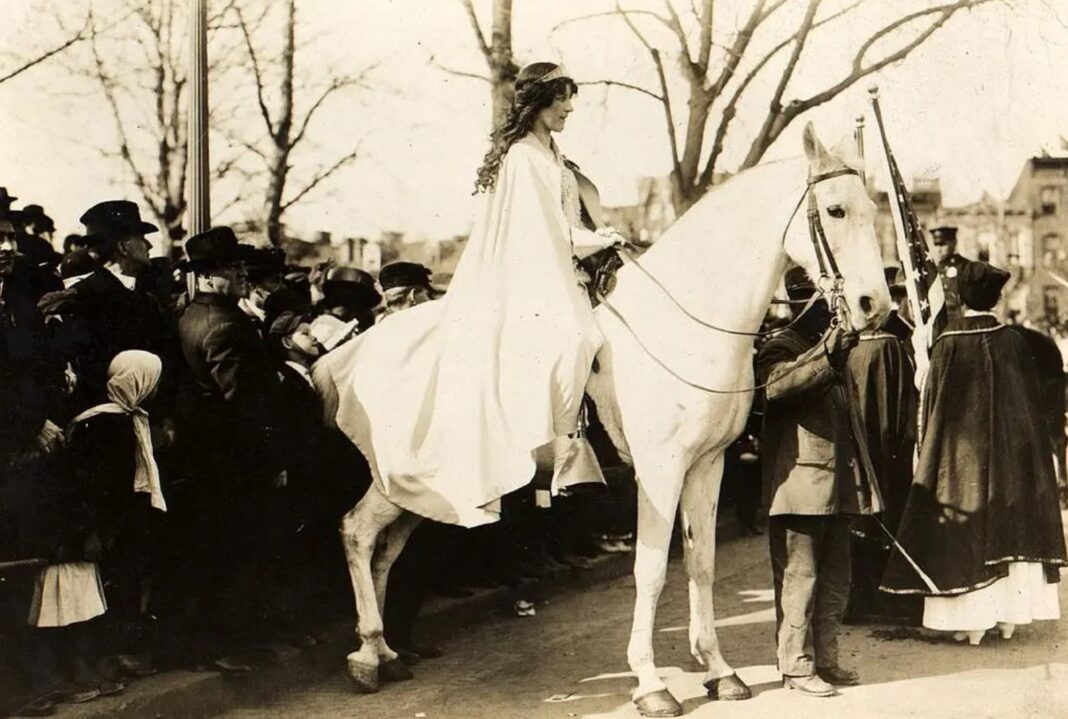
Brooklyn native Inez Milholland became a labor lawyer and the local “Joan of Arc” of the suffragist movement. She was born into a progressive and successful family at 179 Bainbridge Street; her father, John, helped establish the Men’s League for Woman Suffrage. Inez took this political pedigree with her to Vassar College. When the president of Vassar banned discussions of women’s suffrage on campus, Milholland led a group of suffrage-minded students to a cemetery adjacent to the campus. Under the motto “Come, let us reason together,” the Vassar Votes for Women club was born. Soon, two-thirds of the student body was involved, and Milholland held meetings dedicated to both suffrage and socialism.
Milholland continued to carry the banner of the suffragist movement. After graduating from NYU School of Law in 1912, she dedicated herself to labor law, anti-militarism, and universal suffrage. In 1913, she famously led the Woman Suffrage Procession down Pennsylvania Avenue in Washington, D.C., riding a white horse and dressed in a cape and tiara. Behind her, five thousand women marched with bands and cavalry brigades to present the “Great Demand” for universal suffrage.
In 1916, Milholland embarked on a lecture tour for the National Woman’s Party. During an event in Los Angeles, she collapsed on stage. Her last public words were a challenge to President Wilson: “Mr. President, how long must women wait for liberty?” At the age of 30, Inez Milholland had seemingly given her life for the right to vote, and she was honored as a martyr of the movement.