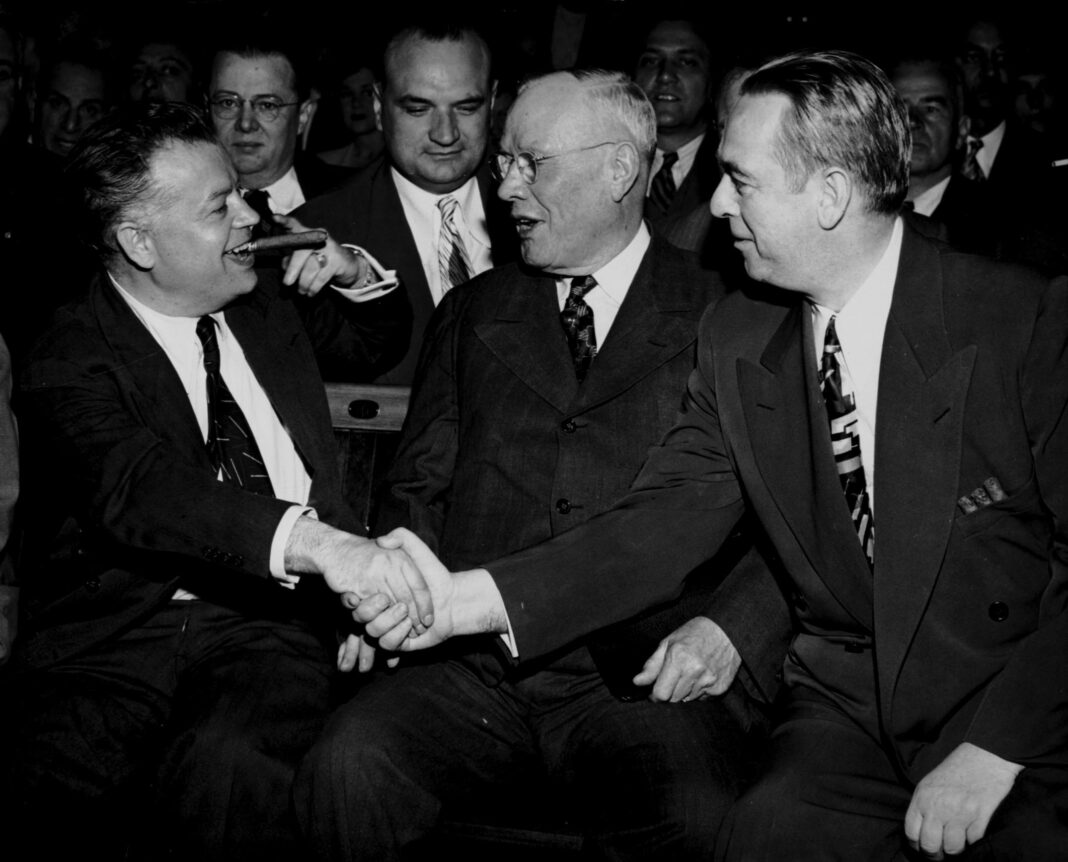

In 1945, New Yorkers elected William O’Dwyer as their mayor. He immigrated to the United States from the tiny town of Bohol in Ireland. Here, he had a brilliant career in city hall before becoming a judge, prosecutor, and brigadier general in World War II. William O’Dwyer went through the crucible of Brooklyn, serving as district attorney and crushing the Brooklyn rackets. It was this achievement that made O’Dwyer almost a national hero, after which he was able to become mayor of New York City. As mayor, he skillfully handled a series of crises as New York transitioned from global war to domestic peace.
But shortly after his re-election in 1949, a scandal erupted in Brooklyn that led to 188 indictments and 150 convictions of police officers and players who ran an illegal bookmaking operation. It turned out that the police had been tapping the bookmakers’ phones—not to make arrests, but to ensure that they received their share of the $20 million in profits. This corruption scandal in the Brooklyn and New York police departments received widespread publicity, although it did not affect William O’Dwyer. Nevertheless, it happened during his tenure, and his reputation was tarnished. For more details, visit brooklyn-yes.com.
Assignment to Mexico

In early August 1950, rumors that New York City Mayor William O’Dwyer was about to retire became a secret in Polichinelle. Everyone knew that President Harry Truman was about to appoint him ambassador to Mexico, thus getting him out of New York before the man could bring down the entire Democratic Party. In response, O’Dwyer reassured himself that nothing was going to happen, but he was deluding himself.
Only eight months into his second term as mayor, the surrounding dams had burst, and he could no longer influence anything, let alone hold anything back. It was time to pack his bags. This is despite the fact that he was considered the undisputed favorite for the Democratic nomination for governor of the state.
But that prospect seemed to evaporate on August 15, when O’Dwyer unexpectedly announced his resignation from the mayor’s office, effective two weeks later. The only question on everyone’s mind was why, which was the same question journalists asked him at Penn Station when he returned from Washington with Truman’s appointment in his pocket. He replied without batting an eye that it was for the president to answer.
He told the inquisitive reporters that he was in fact leaving New York politics completely, finally, and irrevocably. The only question that William O’Dwyer did not have the heart to answer was about the Brooklyn Grand Jury report, which revealed that his many angry accusations against District Attorney Miles McDonald’s racketeering investigation were unfounded. To this question, William O’Dwyer replied that he had no further comment.
Dismissal from office

In his last days in office, he did all the necessary and important things. For example, William O’Dwyer took care of his own life pension and promoted or increased the salaries of many loyal friends. For example, his personal driver became a deputy police commissioner. O’Dwyer’s assurances that this was in the best interests of the city were enough for the Evaluation Committee.
On August 31, William O’Dwyer, then 60 years old, said goodbye to 30,000 New Yorkers in the park of City Hall. He stood in front of the citizens as an irreplaceable father of every city, a kind of brilliant guy born in Mayo County who once worked as a coal shoveler, then became a policeman, lawyer, and magistrate. And later he made himself famous throughout America as a district attorney who crushed the Brooklyn racket without batting an eye and was finally elected mayor of all of New York City and all of its good people who lived here.
He inherited a financially deprived postwar city from Fiorello LaGuardia, the 99th mayor of New York. William O’Dwyer built schools, hospitals, and lots of housing. Speaking to the crowd, he tearfully told the audience, which included about 30,000 people, that New York mayors sometimes inevitably face controversy and disagreement. He also added that his achievements will live on in the public’s mind long after these disagreements are forgotten. O’Dwyer hoped to be remembered as a decent man and was ready to accept the judgment of history.
Then the 100th mayor of New York City boarded the 20th Century Limited for California, and he was gone.
What really happened

It was he who suggested that President Truman “exile” William O’Dwyer to Mexico City, believing that it would be the right place.
The Daily News wrote about the resignation at the time that many people would think that there was very little candor in the whole deal. Because the truth was, even nine years later, the old smell was still hanging around William O’Dwyer. As Brooklyn district attorney, he had steadfastly refused to press charges against gangster Albert Anastasia. As a result, there was no satisfactory answer to the mysterious death in 1941 of a police-protected murder witness.
A special grand jury in 1945 publicly condemned O’Dwyer for gross negligence and mismanagement. Although he dismissed the report as slanderous, it was an election year and he still became mayor for the second time, winning the election. But that old trouble came back to haunt him again during his re-election as mayor in 1949. Some considered him to be a mafia man in the mayor’s office, and the difficult election campaign left him exhausted and exhausted.
Incidentally, among those who considered his performance as Kings County District Attorney unsatisfactory were even several of his own assistant prosecutors. One of them, Miles McDonald, held O’Dwyer’s former position. Meanwhile, on Christmas Day, 1949, the newly re-elected mayor charmed the city by marrying the glamorous 33-year-old socialite Sloane Simpson, and the newlyweds took off on a honeymoon that made news around the world.
When O’Dwyer returned, he discovered that the Brooklyn Eagle had published an article linking NYPD officers to the city’s bookies. District Attorney MacDonald had just launched the most selective police corruption investigation since the Seabury hearings 20 years earlier.
The grand jury in the McDonald case had been making headlines all spring. Police officers appeared for questioning one after another, and then were quickly dismissed from the police force. Some of the accused police officers were old friends of William O’Dwyer, who, for his part, criticized the investigation at every opportunity.
Moreover, it seemed that the former district attorney was working hard to derail it. However, it was clear that O’Dwyer’s successor actually had information about many of the officers who were not clean, and that things were about to blow up. The Democratic Party’s mediator, boss Ed Flynn, immediately went to the White House.
Mexican happy ending

And two weeks after O’Dwyer and his fiancée left the city, there was a media explosion. On the morning of September 15, Miles McDonald’s men arrested Brooklyn bookmaker Harry Gross and announced the destruction of a gambling business with an annual profit of $20 million, which had long enjoyed the support of many high-ranking police officials.
Gross, in turn, admitted that he paid police officers $1 million a year. The sensational revelations led to the most spectacular upheaval in the history of the NYPD, bringing Senator Estes Kefauver’s anti-crime committee to the city and significantly revitalizing local politics, as acting Mayor Vincent Impellieri quickly found himself surrounded by demands to throw out the entire gang, as one opponent put it, that he inherited from the fugitive mayor.
Recalling William O’Dwyer’s farewell speech before leaving for Mexico, some recalled his pathetic statement that he was ready to wait for the trial and history. As subsequent events have shown, history did not delay, and he did not have to wait long for his trial. William O’Dwyer sensed the danger. So he left the election campaign in time. Even though President Harry Truman was almost too late, throwing him the same Mexican lifeline.
Source: