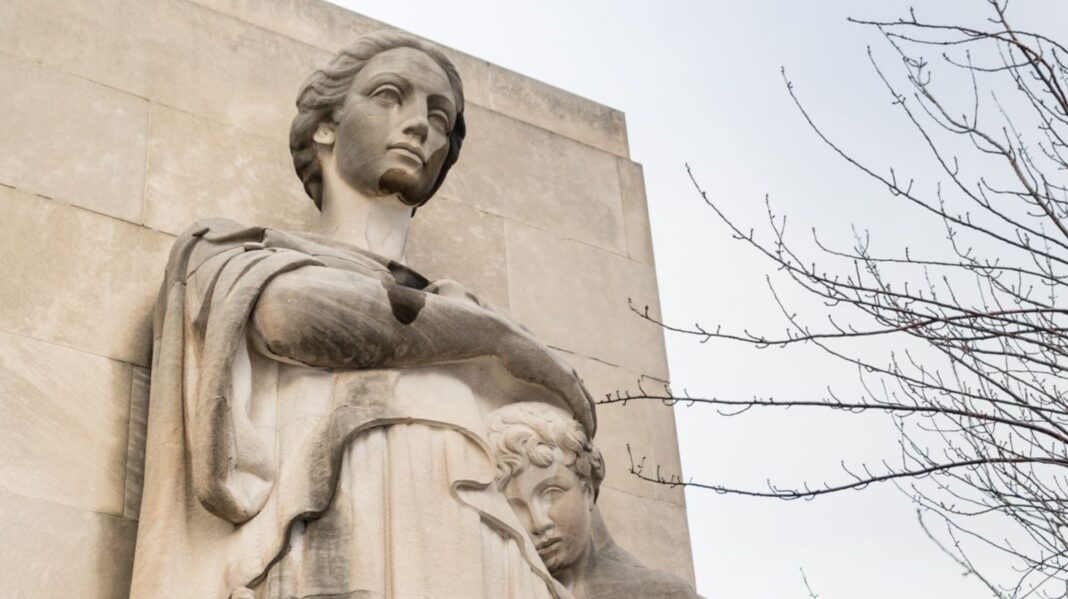

The Brooklyn War Memorial was created after a large-scale competition was announced to create a monument to all Brooklynites who participated in World War II. The design competition was initiated by then-Commissioner of Parks Robert Moses. In 1944, the design by architects Stuart Constable, Gilmore D. Clark, and W. Earl Andrews of Eggers and Higgins was selected from 243 entries. The granite and limestone memorial, featuring two large high-relief sculptures by Charles Keck, was unveiled on November 12, 1951. For more details, visit brooklyn-yes.com.
Cadman Plaza Park

Before talking about the Brooklyn War Memorial, a few words about the place where it was built. We are talking about Cadman Plaza Park, which covers an area of 10.4 acres and is located between the historic Brooklyn Heights neighbourhood and the borough’s centre. The park is named after the Reverend Dr. Samuel Parks Cadman. He was a well-known pastor of the Brooklyn Congregational Church, where he served for nearly 40 years.
Cadman Plaza was built first. It served as a vehicle ramp for the Brooklyn Bridge. Later, a quiet green space appeared, with places to sit, walk, and play games. In 2007, a major restoration was carried out, resulting in an entrance garden and artificial turf on the central lawn. This means that everyone, especially children, can enjoy it all year round.
And, of course, the main feature of this park is the Brooklyn War Memorial, made of granite mixed with limestone. This monument honours the 300,000 residents of Brooklyn who, to one degree or another, participated in World War II. The monument includes a shallow stone plaza. It stretches from a seven-meter wall, at the edges of which are two sculptures by Charles Keck.
One sculpture depicts a male warrior and is located on the left, while the other depicts a woman with a child, a mother, and can be seen on the right. According to the artist’s concept, these symbols represent Victory and Family. The main hall of the memorial bears the names of 11,000 Brooklyn residents who died during World War II. This area is closed to the public, but relatives can make an appointment to view the interior.
Among the features of the Brooklyn War Memorial, it is worth noting the symmetrical paths and London plane trees, a characteristic type of tree that was particularly popular during the reign of Parks Commissioner Robert Moses. These trees are planted in parallel on both sides of the park. Here, on the north side of the park, there is a bust of William Jay Gaynor. He was mayor of Brooklyn from 1910 to 1913.
In addition, he worked as a journalist, lawyer, and judge for the New York Supreme Court. Gaynor lived in Park Slope, but during his tenure as mayor, he was known for walking across the Brooklyn Bridge to City Hall in Manhattan every day.
Critics of the memorial

But let’s get back to the memorial itself. This huge monument honors Brooklynites who died in World War II and serves as a reminder of the sacrifices ordinary people made for the victory of their country. Some believe that the Brooklyn War Memorial, for such a grand and important monument, has relatively few visitors and is not particularly popular among residents and visitors to the borough. The reason for this situation is said to be its unfortunate location — on the outskirts of Cadman Plaza, albeit on a huge piece of land.
Skeptics, despite the importance of commemorating World War II, believe that the memorial is a lost monument, similar to an ancient artifact that appears before your eyes when you step out of the thick undergrowth onto the lawn and want to exclaim, “There it is!” It is known that at the beginning of its existence, the local square was rather poorly maintained, which reinforced such associations.
For example, Brooklyn critic Leslie Katz wrote in his article for the Nation newspaper back in 1962 that the memorial is a stone billboard with two apathetic stone giants symbolizing grief. In his opinion, the problem is that although the statues themselves are quite aesthetic, the wall behind them is too large, leaving too much space between the figures and thus losing any personal sense of closeness.
And here another argument of the memorial’s critics comes to the fore. They argue that mothers and nannies with children, students, and children themselves, who like to play here, usually relax or entertain themselves in front of these figures and the wall itself on artificial turf.
But there is no interaction between the monument and those present, except that the memorial is used as a boundary for children playing, beyond which they cannot go. The existing spaces have nothing in common with each other. The grief, tragedy, and sorrow of that war are not felt at all. It is in this, critics believe, that there is a huge discrepancy and inconsistency.
Project authors

The Brooklyn War Memorial was designed by Eggers & Higgins. The future founders of the company worked for Russell Pope, a renowned architect and proponent of the City Beautiful movement. It was Pope who designed the Jefferson Memorial, the National Archives, and other buildings in Washington, D.C.
Otto Reinhardt Eggers worked as a draftsman and was Pope’s right-hand man for many years. Daniel Paul Higgins also worked for Pope. After his death in 1937, the pair changed the name of the firm to Eggers and Higgins.
The two had a very successful partnership, especially from the 1940s to the 1960s, designing many large and prominent buildings in New York, Washington, and Hartford, Connecticut. Higgins died in 1953, Eggers in 1964. The firm became Eggers Partnership in 1970 and is now part of RMJM Hillier, a leading multinational architectural firm.
According to the authors’ idea, the Brooklyn War Memorial was supposed to have a rather austere appearance. So, the wall was designed as a canvas and backdrop for sculptures and inscriptions, which, in turn, were created by Charles Keck in honor of those who died heroically in World War II. A few words about the sculptor Keek.
He was once an assistant to the famous sculptor Auguste Saint-Gaudens, an artist who worked in the Beaux-Arts style and created some of the country’s finest bronze portraits, including Abraham Lincoln and many of his Civil War generals. In addition to these sculptures, Charles Keek is the author of the famous sculpture of Father Duffy in Times Square in Manhattan.
Working on the memorial statues, Keck “dressed” both male and female figures in classical robes and gave their faces a gloomy and sad expression. Between the two, an inscription dedicated to Brooklyn residents who died in World War II is carved on the wall.
Why breathe in Brooklyn

At one time, Robert Moses planned to build a memorial for each of the five boroughs of New York City, but the monument in Brooklyn was the only one that was actually built. The reason for this was that only Brooklyn raised enough funds for such a grandiose monument, regardless of what critics say.
Moreover, even this monument was not completed on the scale that was planned in the initial stages of the project. In this regard, it should be noted that four times more soldiers died in World War II than in World War I.
Sources: